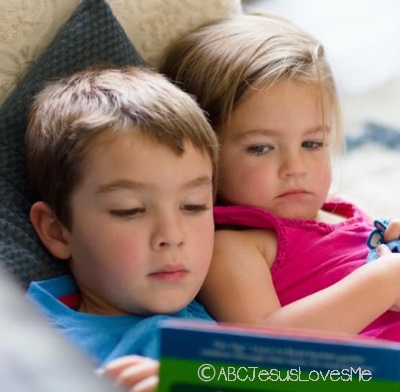
Before children can become confident readers, they need to understand that letters represent sounds. This is the purpose of phonics. Rather than memorizing words, children learn to connect letters with their sounds and blend those sounds together to read new words. Phonics should be taught in a fun, hands-on way through games, songs, books, and everyday experiences. As children build these skills over time, they gain the confidence they need to become successful readers.
Phonics is most effective when it is taught one step at a time. My husband and I both learned to read using the whole-language approach, which relied heavily on memorizing words and using picture or context clues. While we learned to read, we both struggled with spelling and sounding out unfamiliar words. We wanted a stronger foundation for our own children.
That experience shaped the ABCJesusLovesMe Curriculum. Throughout the Curriculum, reading readiness is built on a phonological approach, teaching children that letters represent sounds through Active Phonics. As children master individual letter sounds, they learn to blend those sounds together to form words. This method gives children the tools to read unfamiliar words with confidence instead of relying on memorization.
Children need many opportunities to hear, see, say, and use letter sounds before they are expected to read words. Keep phonics lessons short, playful, and repeated often. Through songs, games, books, and hands-on activities, children develop the strong foundation they need to become successful readers.
Remember that phonics is only one part of learning to read. Reading aloud every day, talking with children, singing songs, and playing with language all help build the strong literacy foundation they need for future success.
Below are optional Bible-based pronunciations to use for each letter.
| A /a/ apple | J /j/ Jesus | S /s/ sun |
| B /b/ boat | K /k/ King | T /t/ tithe |
| C /c/ Caleb | L /l/ light | U /u/ umbrella |
| D /d/ David | M /m/ Mary | V /v/ vine |
| E /e/ elephant | N /n/ Noah | W /w/ water |
| F /f/ family | O /o/ octopus | X /x/ exit |
| G /g/ God | P /p/ people | Y /y/ young |
| H /h/ heart | Q /q/ queen | Z /z/ zero |
| I /i/ infant | R /r/ river |
Tune: Twinkle, Twinkle Little Star
A /a/ apple, b /b/ ball
C /c/ cat, d /d/ dog
E /e/ egg, f /f/ fish
G /g/ God, h /h/ hand
I /i/ igloo, j /j/ Jesus
K /k/ kite, l /l/ lamb
M /m/ mouse, n /n/ nest
O /o/ octopus, p /p/ pig
Q /q/ quilt, r /r/ run
S /s/ sun, t /t/ tooth
U /u/ umbrella, v /v/ vine
W /w/ web, x /x/ box
Y /y/ yarn, z /z/ zipper (repeat last two phrases of the song)
I can say each letter sound!
After hearing several friends rave about the LeapFrog Fridge Phonics® Magnetic Set, I decided to purchase one for my children. I quickly understood why it receives so much praise. They loved placing the letters into the base and happily sang along several times each day.
If you are unfamiliar with the set, each time a letter is placed into the base, it sings to the tune of "The Farmer in the Dell," introducing the letter and the phonetic sound (or sounds) it makes. Inspired by this, I created a rhyme for each letter that connects to a Bible story. Although these rhymes are no longer included in the ABCJesusLovesMe Curriculum, they are still a fun way to reinforce letter sounds at home or in the classroom.
Unlike the LeapFrog set, my rhymes focus only on the short vowel sounds and the most common consonant sounds to keep beginning phonics simple. They can easily be sung along with the LeapFrog tunes.
a - Adam and the Animals
b - Obey and Believe the Bible
c - Cain could not lie to God
d - Down and down the rain fell down
e - Encourage everyone to believe
f - Follow God’s Commandments
g - God gave them Great big Grapes
h - Hooray, the high walls tumbled down
i - Hannah prayed for an infant
j - Just listen, God is calling
k - God kept King David safe
l - Daniel in the Lion’s Den
m - Mary and the Manger
n - 12 were the number of men
o - It's our job to not be fools
p - People Praise and Pray to Jesus
q - Don’t quit praying and reading God’s Word
r - Run to Jesus right away
s - Sow the seeds so they can Grow
t - Take time to tend to others
u - No one was Under Fed
v - Jesus Loves Me Very Much
w - Jesus Walked on Water
x - Jesus’ death X’ed out my sins
y - I’m not too young to believe
z - Zero, zip, no sin at all
Sing each rhyme to the tune of "Farmer in the Dell" and may also be sung with the LeapFrog Magnetic Set.
For example:
A says /a/
A says /a/
Adam and the Animals
A says /a/
Starfall - While I am generally very cautious about screen time for young children, I make an exception for high-quality educational resources used in moderation. If your child has limited screen time, Starfall can be a fun way for the two of you to spend a few minutes learning letters together. Its engaging songs, animations, and activities reinforce letter names and sounds, making it an excellent supplement to hands-on learning. Sit with your child, interact with the lesson, and talk about what they are learning to make the experience even more meaningful.
Poem-on-the-Go: Start with a simple line like "I really like to take a walk." Have each person add to the rhyme. For example: Except when I forget my sock... And then I step on a rock...