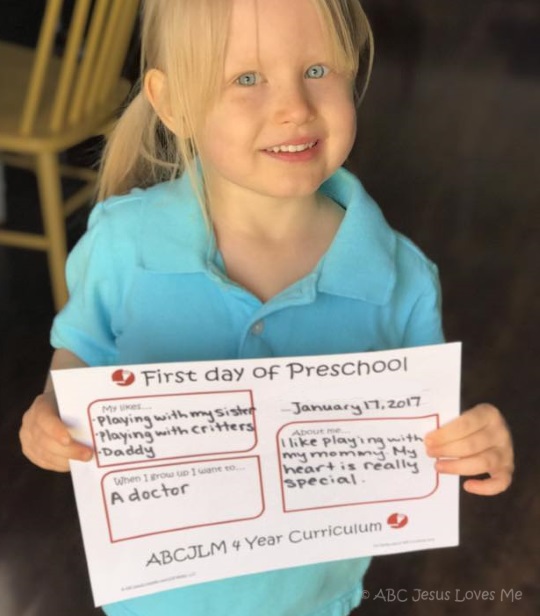
The ABCJesusLovesMe Preschool Curriculum is a comprehensive, research-based preschool Curriculum focusing on Bible, academics, and development. Each of the Curricula contains goals and objectives to gauge the child's learning and growth. Beyond the weekly lesson plans, ideas and materials are provided to support parents and teachers along the way.
To equip and empower adults to be intentional and enable children to learn through play.
Intentional learning through play.
Hear, O Israel: The Lord our God, the Lord is one. Love the Lord your God with all your heart and with all your soul and with all your strength. These commandments that I give you today are to be on your hearts. Impress them on your children. Talk about them when you sit at home and when you walk along the road, when you lie down and when you get up. Tie them as symbols on your hands and bind them on your foreheads. Write them on the doorframes of your houses and on your gates. Deuteronomy 6:4-9
I believe children are blessings from God. He has created each child unique and special. Learning should be incorporated into the child's day instead of controlling his/her day. I believe preschoolers should be able to explore, play, and learn new things through trial and error, not through "drill and kill." The comprehensive and research-based ABCJesusLovesMe Curricula allow success for the most energetic child while allowing for supplemental material to be added for the child who prefers more sit-down activities.
Using the five ABCJLM Preschool Curricula the child will be exposed to the following subject matters through play-based activities, crafts, and teaching:
Each Curriculum and Lesson Plan features clear objectives, supplemental materials, and suggested activities for the week. To support diverse learning styles, developmental delays, and those with English as their second language, you can find additional teaching strategies in the Supportive Ideas section. Finally, creating a Preschool Notebook serves as a portfolio to organize the child's work, track progress, and share their achievements with others.
ABCJesusLovesMe chooses to leave technology education to families and later school years.
The ABCJesusLovesMe Preschool Curriculum is a comprehensive, research-based program built on educational theory with a biblical worldview. Designed around a play-based, whole-child philosophy, it supports age-appropriate academic, social-emotional, language, physical, and spiritual development.
Each level includes age-appropriate goals and objectives to guide a child's growth and learning, while providing practical ideas, materials, and support for the caregiver in a home or preschool setting. The Curriculum aligns with child development research by incorporating expectations set by the American Academy of Pediatrics, state early learning standards, and feedback from kindergarten teachers on readiness skills.
"A research-based early childhood curriculum is consistent with research on how children develop and learn. It provides rich content and teaching practices that are shown to support children's learning and development. A research-based curriculum focuses on domain-specific, developmentally appropriate content and skills that contribute to children's later development in that domain. A research-based curriculum is also content-rich, meaning that it provides broad and varied experiences and activities that promote children's learning and development. A rich curriculum invites children to think deeply about content that interests them and builds on their prior knowledge and experiences. Finally, a research-based curriculum offers a sequence of learning experiences based on children's developmental progressions." Research-Based Curriculum. HeadStart. Source
"Without doubt, reading with children spells success for early literacy." Simple Strategies for Creating Strong Readers -- Helping Your Child Become a Reader. US Dept of Education. Source Accessed 18 Feb. 2026.
"Children who can recite eight nursery rhymes by age four often become a strong reader and speller by age eight. This is because rhymes help build awareness of the sounds inside words - a key skill for reading." Fox. M. (2005). Reading Magic. Pan Macmillan.
"Toddlers can begin to learn simple songs and nursery rhymes. These teach them how to play with words, recognize patterns, and develop rhyming and rhythm skills. As toddlers are exposed to books, they will begin to recognize letters and pictures and start identifying concepts of print while they read with adults or look at books independently. Older toddlers also begin recognizing alphabet letters, words, numbers, colors, and shapes in their environment. There are many PLAY BASED activities that parents and caregivers can use to expose children to these concepts in open-ended and creative ways. Kids are naturally curious and learn so much through play!" Kristina. 6 Skills Toddlers Need to Learn. (2022, August 25). Toddler Approved. Source
" Being able to manipulate the sounds of spoken language - phonological awareness - is highly related to later success in reading and spelling." Birsh, J. R., & Carreker, S. (Eds.). (2018). Multisensory Teaching of Basic Language Skills (4th ed.). Paul H. Brookes Publishing.
"Parents typically introduce color by saying “look at the green ball,” or “that’s a red apple.” However, the Stanford study found that reversing the order—“the ball is green” or “the apple is red”—made a significant difference in a toddler’s ability to identify colors. ...Learning colors and shapes sets the foundation for learning letters and numbers. ...Fill a series of boxes or bins with distinctly colored items that match. For example, the first one has all red items, the next one all yellow, etc. Allow the child to take things out and put them back, letting them get the hang of grouping items together." The better way to help your toddler learn colors. LoveEvery. Source
"Sky writing involves engaging the large "learning" muscles of the upper arm and shoulder. The movement of these muscles produces a strong neurological imprint of letter shapes (Waites and Cox, 1976). For sky writing, the arm of the writing hand is fully extended and tenses. Students use the whole writing arm, with fingers extended, to write large letters in the air, with a large model in front of them, to develop muscle memory. The nonwriting hand is placed on the upper arm or shoulder of the writing arm to create tension and help students feel the individual strokes more discernibly." Birsh, J. R., & Carreker, S. (Eds.). (2018). Multisensory Teaching of Basic Language Skills (4th ed.). Paul H. Brookes Publishing.
"Families need to speak to their children using everyday, conversational words and sentences. Families also need to read to children daily and expose them to print in as many ways possible. The more words that children are exposed to, the stronger their language skills are and hence the stronger their literacy skills will become." Birsh, J. R., & Carreker, S. (Eds.). (2018). Multisensory Teaching of Basic Language Skills (4th ed.). Paul H. Brookes Publishing.
"It turns out that the sheer quantity of speech infants are exposed to did not significantly affect their later language, but that the amount of quality speech they heard was important (see also Hirsh-Pasket et al., 2015). Sigelman, Carol K. and Elizabeth A. Rider. Life-Span: Human Development 9e. 2018. Cengage Learning.
"Children understand concepts more easily when multiple senses are involved. Offer children a variety of ways to explore the alphabet by using felt or sandpaper letters, making letters with playdough or clary, using magnetic letters...." Birsh, J. R., & Carreker, S. (Eds.). (2018). Multisensory Teaching of Basic Language Skills (4th ed.). Paul H. Brookes Publishing.
"A great way to really reinforce color recognition is to just work on one color at a time. Every week choose one color, and then have everything you do that week be related to that color." 7 Fun Ways to Teach Colors to Preschoolers. (2025, August 1). Green Kid Crafts. Source
Reading Books: "Repeat familiar words and phrases, and then get your toddler to fill in the words in familiar stories. Or try pausing and letting your toddler finish sentences for you – for example, ‘Moo said the …?’ Ask your toddler to name, describe or act out what they see on the page. For example, ‘What’s that? That’s right – it’s a monkey. What is the monkey doing? Can you jump up and down like that monkey?’ ...Use your voice, gestures and facial expressions to engage your child, and to help them understand the meaning of words and pictures. Turn the pages slowly, give your child plenty of time to look at the pictures, and talk with your child about what they see." Reading with Toddlers: 18 months-3 Year. RaisingChildren. Source
"Reading to babies is important for healthy brain development and lays the foundation for language and writing skills." 12 Tips to Boost Early Literacy. StartEarly. Source
"To make a read-aloud experience a valuable one and to support children's language skills, teacher should consider implementing the following practices:"
- Picture Walk: Looking at the cover, making predictions, talk about the author and illustrator
- Read with expression: Use gestures, props
- Use open-ended questions: Why do you think...?
- Expressive language: Ask what the author means by more abstract lines.
- Child Reading: Allow the child to read more and more of the story after hearing it several times.
- Pragmatics: Look at the character's actions and facial language.
- Library Center: Place the book in the library center for the child to read independently or in small groups.
Based upon ideas shared in Birsh, J. R., & Carreker, S. (Eds.). (2018). Multisensory Teaching of Basic Language Skills (4th ed.). Paul H. Brookes Publishing.
Word Families: "Creating a word family chart with the whole class or a small group builds phonemic awareness, a key to success in reading. Students will see how words look alike at the end if they sound alike at the end — a valuable discovery about our alphabetic writing system. They’ll also see that one little chunk (in this case “-an”) can unlock lots of words!" Between the Lions. Meet the Word Families. ReadingRockets. Source
"A beginning reader's instant letter recognition is a strong predictor of reading success. Knowing the names of the letter can facilitate the learning of the letter sounds because many sounds are embedded in the letter names." Birsh, J. R., & Carreker, S. (Eds.). (2018). Multisensory Teaching of Basic Language Skills (4th ed.). Paul H. Brookes Publishing.
"Phonemic awareness helps children get ready for reading and writing by helping them understand that words are made of smaller sounds. It also helps them sound out words as they read and write. One of the key differences between readers who struggle and those who don’t is strong phonemic awareness." Phonemic Awareness: What Is It and Why Is It Important? National Center on Improving Literacy. Source
"Teacher labeling a drawing or painting with the child's own words [gives the child] the opportunity to express in words what has previously only been expressed through a painting or drawing." Birsh, J. R., & Carreker, S. (Eds.). (2018). Multisensory Teaching of Basic Language Skills (4th ed.). Paul H. Brookes Publishing.
"Reading aloud to your child every day for at least 15 minutes helps to build your child’s vocabulary, pre-literacy skills, and form social-emotional bonds." Read for 15: The Power of Reading Aloud to Your Child. Early Learning Coalition of Palm Beach County. Page no longer found.
"Songs, finger-plays, and silly rhymes allow children to play with language and develop an awareness of cadence, rhythm, and different speech patterns. These can be introduced formally at circle time and then used informally throughout the day when it's time to clean up or go outdoors or get ready for lunch." Birsh, J. R., & Carreker, S. (Eds.). (2018). Multisensory Teaching of Basic Language Skills (4th ed.). Paul H. Brookes Publishing.
"In one study, 4-year-olds in preschools with strong academic thrusts gained an initial advantage in basic academic skills such as knowledge of letters and numbers but lost it by the end of kindergarten (Hyson, Hirshi-Pasket, & Rescorla, 1991). What is more, they proved to be less creative, more anxious in testing situations, and more negative toward school than children who attended preschool programs with a social rather than academic emphasis. Similarly, Deborha Stipek and her colleagues (1995) have found that highly academic preschool programs raise children's academic achievement test scores but decreased their expectancies to success and pride in accomplishment. So it may be possible to undermine achievement motivation by overemphasizing academics in the preschool years." Sigelman, Carol K. and Elizabeth A. Rider. Life-Span: Human Development 9e. 2018. Cengage Learning.
"Young children who learn to read early have more exposure to print, which solidifies reading and writing skills. Children who lag behind in reading skill development have less exposure to print, few opportunities to practice reading, and few opportunities to develop vocabulary and reading comprehension strategies." Birsh, J. R., & Carreker, S. (Eds.). (2018). Multisensory Teaching of Basic Language Skills (4th ed.). Paul H. Brookes Publishing.
Introducing Syllables
"A syllable is a word or part of a word made with one opening of the mouth. ...The number of syllables [is determined] by counting the number of times the mouth opens when pronouncing the word."
- Student repeats words of varying lengths, one at a time, while looking in a mirror and observing how many times their mouths open when each word is pronounced.
- Repeat each word while cupping their jaw in their hands and feeling how many times their jaws drop or their mouths open.
Syllable Activities
- Identify or generate short words (farm, feet, fat, fork, food) and long words (February, firefighter, fisherman).
- Repeat words dictated by the teacher. Clap or tap out the number of syllables. Begin with compound words (playground, flashlight, cowboy), then move to two-syllable words and then on to words with three or more syllables.
- Repeat words and move a counter (e.g. block, button, penny) for each syllable they hear. Using counters provides a visual and kinesthetic anchor for the sounds.
- Repeat a word with two or more syllables dictated by the teacher. Students are asked to repeat the word again, omitting a designated syllable (Rosner, 1975).
Birsh, J. R., & Carreker, S. (Eds.). (2018). Multisensory Teaching of Basic Language Skills (4th ed.). Paul H. Brookes Publishing.
Five levels of phonological awareness skills by researchers David Chard and Shirley Dickson.
1. Rhyming songs
2. Sentence segmentation
3. Syllable segmentation and blending activities
4. Onset-rime blending and segmentation activities
5. Blending and segmenting individual phonemes
Houghton Mifflin Harcourt. n.d. “Progression of Phonological Awareness Skills.” Accessed April 21, 2026. Source.
"It is important when initially working on segmentation to do these tasks orally, without the use of written sentences, so they are able to distinguish the breaks in words within a sentence on their own. Once this skill develops, you can later work with written sentences and point out spaces between words that show when words begin and end." Santoro, K. B. (2023, October 20). Help your child learn to read: Phonological awareness games for preschoolers—segmenting and blending. PediaSpeech Services. Retrieved April 21, 2026. Source.
"Use spatial language during block play with children.... Spatial language includes words that describe an object’s or a person’s location in space, for example: on top, underneath, next to, on the side, behind, in front of. Research has found that exposing children to spatial language starting in early toddlerhood predicts both the amount of spatial language children produce and better performance on spatial problem-solving tasks at age 4.5 (Pruden, Levine, & Huttenlocher 2011)." Parlakian, Rebecca. "Rocking and Rolling. Building New Skills: Block Construction in Toddler Settings." Young Children, vol. 75, no. 1, Mar. 2020, pp. 72–77. Page no longer found.
Developmental Progression for Number Knowledge
1. Subitizing
Say how many objects there are without counting.
2. Meaningful Object Counting (Cardinality)
Count one object at a time and understand the last number said is the total.
3. Comparing Groups by Counting
Look at two groups, count them, and tell which has more.
4. Number-After Knowledge
Start at any number and say the next number without starting at one.
5. Comparing Nearby Numbers Mentally
Tell which number is larger when the numbers are close together.
6. One More
Understand that the next number is one more (eight is one more than seven).
Frye, D., Baroody, A. J., Burchinal, M., Carver, S. M., Jordan, N. C., & McDowell, J. (2013). Teaching math to young children: A practice guide. National Center for Education Evaluation and Regional Assistance (NCEE), Institute of Education Sciences, U.S. Department of Education. Source
"If nothing else, the simplest and most efficient way to help children engage, apply, and love God's Word is to read it with them regularly." Smith, Brandon and Jeremy Writebol."Tips for Teaching Kids the Bible." Lifeway. Source.
"By modeling your dedication for God’s Word; creating a consistent routine; teaching the Bible text; connecting the lesson to real life (their real lives!); making it interactive, interesting, and fun; and praying together, you can help children grow in their knowledge of and love for God’s Word, as you also equip them with the tools they need to grow in their faith and make a positive impact within their home and in their community." O'Donnel, Douglas. "7 Tips for Teaching the Bible to Children." June 12, 2023. Source.
"Repetitive activities and routines: Knowing what to expect and being able to use skills are both comforting and confidence-building to young children. Children of this age rarely get “bored.” Infants and toddlers have a great time when teachers sing the same songs over and over and bring out familiar teaching objects one-by-one." Mission Bible Class. Source.
"When you select the lessons for your loop, pick big picture lessons that lay a foundation of the character of God and the truth of God’s Word. This helps even the youngest children know the “basics”: who God is, what he has done for us, and how we should respond. Later lessons in preschool and beyond will build on this foundation." Ham, Ken. 5 Tips for Teaching Babies and Toddlers Biblical Truth. July 29, 2023. Source.
Comprehension Questions: "When you ask simple questions, you’re doing much more than “quizzing” them to ensure they were paying attention. You are actually leading them, interactively, in a time of interpreting and applying God’s Word. And you are preparing them to engage the Scriptures directly on their own in the years to come." Nielson, Jon. 6 Ways to Teach Your Kids the Bible. July 26, 2017. Source.
"Love the Lord your God with all your heart and with all your soul and with all your strength. These commandments that I give you today are to be on your hearts. Impress them on your children. Talk about them when you sit at home and when you walk along the road, when you lie down and when you get up." Deuteronomy 6:5-7
Developmental Milestones per Age:
Preschool State Standards:
"Fine motor skills activities for children are the best way to ensure proper development and practice of fine motor skills to promote the most functional use of a child's hands. ... Childhood is the critical time to properly develop these muscles... ."
The Secret to Making Fine Motor Skills Activities for Children Fun. Source
"Reading books aloud to children stimulates their imagination and expands their understanding of the world. It helps them develop language and listening skills and prepares them to understand the written word."
Cullinan, B. & Bagert, B.
"Getting preschoolers to take over the brushing, scrubbing and rinsing themselves is an important step in the development of a preschooler's independence. Not only does it give parents a welcome break and help ditch the dirt in the short term, but teaching basic hygiene concepts to children at a young age will form the groundwork of a healthy lifestyle in the future."
Wingerden, P. (2013, December 6). Wash, Brush, Comb! Hygiene Habits for Kids. Source
"Movement is at the very center of young children’s lives. It is an important facet of all aspects of their development, whether in the motor, cognitive, or affective domains of human behavior. To deny children the opportunity to reap the many benefits of regular, vigorous physical activity is to deny them the opportunity to experience the joy of efficient movement, the health effects of movement, and a lifetime as confident, competent movers."
Gallahue, D. (1993). Developmental physical education for today’s children. Dubuque, IA: Brown & Benchmark.
"Music encourages the ability to listen and concentrate. Songs encourage speech and auditory discrimination."
Silberg, J. (2011, July 26). Enriching a Young Child's Life. Source
Writing Development by Age:
"Process art is engaging and exploring with art for the creative process and the joy of creating rather than getting an end product. Unlike traditional art projects where the goal is to create a perfect frame-worthy masterpiece, process art emphasizes exploration, experimentation, and expression. Children are encouraged to use various materials and techniques to create their own unique works without any set expectations or guidelines." Why Process Art Matters: Encouraging Creativity in Kids. Source
Sign Language: "Toddlers need to learn how to communicate using their body language and their words! They will start out with a word or two and eventually can use full sentences! Some toddlers will also use sign language to help them as their words develop." Kristina. 6 Skills Toddlers Need to Learn. (2022, August 25). Toddler Approved. Source
Egg-Shaped and Broken Crayons: "Egg shaped chalk...fit the whole hand without forcing the fingers to grasp the writing tool. One-two inch crayons are the best for children through elementary school. It is almost physically impossible to get a fist around a one inch crayon. This promotes a tripod grasping pattern." Wood, Victoria. Crayons for Toddlers. The OT Toolbox. Source
Pencil Grip: "Students need to be taught the correct way to grip a pencil so they can have optimal control over the pencil point. A tripod grip can support this where the index finger and thumb hold the pencil against the middle finger. Students with a poor pencil grasp may benefit from using tools such as a pencil grip." Sedita, Joan. Teaching Handwriting. (2022, March 1). Keys to Literacy. Source
Handwriting: "Encourage students to begin all uppercase letters from the top and lowercase letters from the middle or top. Practice letters in groups that have similar shapes so students have practice reinforcing the same motor pattern." Sedita, Joan. Teaching Handwriting. (2022, March 1). Keys to Literacy.
"By 16 months, toddlers can scribble with a crayon, and by the end of the second year they can copy a simple horizontal or vertical line and even build towers of five or more blocks." Sigelman, Carol K. and Elizabeth A. Rider. Life-Span: Human Development 9e. 2018. Cengage Learning.
"...Music training boosts foundational speech-processing tasks, spatial skills, the detection of emotional cues, empathy, and baby-size social skills." Medina, J. (2014). Brain rules: 12 principles for surviving and thriving at work, home, and school (2nd ed.). Pear Press.
"Karen Adolph and her colleagues have found that it takes an average of 13 starts and stops over a period of days and sometimes weeks before toddlers show consistent performance of a motor skill. During the transition period of acquiring a new motor skill they are truly taking "one step forward, two steps backward." Sigelman, Carol K. and Elizabeth A. Rider. Life-Span: Human Development 9e. 2018. Cengage Learning.
"In the preschool years, [linguistic skills] are best acquired through language-play that includes rhymes, finger-plays, songs, exploring literature of all kinds including books and poetry, writing messages, expanding oral vocabulary, and learning that reading has many purposes." Birsh, J. R., & Carreker, S. (Eds.). (2018). Multisensory Teaching of Basic Language Skills (4th ed.). Paul H. Brookes Publishing.
"Preschoolers need at least 60 minutes of structured activity and at least 60 minutes of unstructured activity (probably closer to 3 hours). Outdoor play in this age group naturally yields more physical activity." American Academy of Pediatrics. n.d. “Preschooler Timeline.” Accessed April 21, 2026. Source
"Children learn language by hearing it used correctly in context. By recasting and rephrasing what they say, adults provide models of correct grammar, vocabulary, and sentence structure in a natural and engaging way. These models help children understand how language works and how to improve their own communication." Edgar, J. Nov 27, 2024. Effective ways to correct a child’s grammar. Perth Speech Therapy. Source
"Temporal contiguity principle: Students learn better when corresponding words and pictures are presenting simultaneously rather than successively. Spatial contiguity principle: Students learn better when corresponding words and picture are presented near to each other rather than far from each other on the page or screen." Medina, J. (2014). Brain rules: 12 principles for surviving and thriving at work, home, and school (2nd ed.). Pear Press.
"Research shows clearly that children are more likely to succeed in learning when their families actively support them. Families who involve their children in activities that allow the children to talk, explore, experiment and wonder show that learning is both enjoyable and important."
Helping Your Preschool Child. (2005). U.S. Department of Education. Source no longer available.
"Engaging in lots of pretend play has been linked to better performance on tests of cognitive development, language skills, executive function, and creatively (Lillard et al., 2013). Meanwhile, social pretend play is linked to children's understanding of other's perspectives, social skills, and popularity (Connolly & Doyle, 1984, Lillard et al., 2013). Finally, play contributes to healthy emotional development by providing opportunities to act out or express bothersome feelings, regulate emotions, and resolve emotional conflicts (Coplan & Abbreau, 2009). ...So, although children play because it is fun, not because it sharpens their skills, they contribute to their own development by playing. Experts agree that young children often learn best when they can do so in self-chosen, hands-on, and playful ways (Hirsh-Pasket et al., 2009; Lillard et al., 2013)." Sigelman, Carol K. and Elizabeth A. Rider. Life-Span: Human Development 9e. 2018. Cengage Learning.
"High-quality programs empower young children by encouraging them to initiate their own learning activities. The idea that young children initiate their own learning activities rather than act as mere passive recipients of information from others is central to developmentally appropriate practice for young children. Such active learning encourages children to solve their everyday intellectual, social, and physical problems and to assume a measure of control over their environment."
Schweinhart, Lawrence J. (1994, January). Lasting Benefits of Preschool Programs.
"Play is your child's work. Through play children practice the basic skills needed in the classroom -- and in life. Guided play in the right environment will help your child gain the tools she needs to sharpen her thinking, and heighten her sensitivity." Auerbach, Stevanne. Dr. Toy's Smart Play: How to Raise a Child with a High P.Q. (Play Quotient), The Importance of Play and Toys. Source
"When play, love, and work are all involved, learning and development are the most effective. Play is not a luxury but rather a crucial dynamic of healthy physical, intellectual, and social-emotional development at all age levels." Elkind, David. (2007). The Power of Play: How Spontaneous, Imaginative Activities Lead to Happier, Healthier Children. Da Capo Press.
"Early childhood education is rooted in the belief that learning through doing is fundamental for young children." Henninger, M.L. (2009) Teaching Young Children: An Introduction. Pearson.
"Recognizing play as critical for children to experience joy and wonder, early childhood educators incorporate frequent opportunities for play in their teaching strategies. They plan learning environments that provide a mix of self-directed play, guided play, and direct instruction. Direct instruction—for example, providing children with relevant academic vocabulary, pointing out relationships, helping children recognize specific phenomena, or suggesting an alternative perspective—is an important tool for supporting children’s learning." DAP: Teaching to Enhance Each Child's Development and Learning. NAEYC. Source
“When young children hear the same story, song, or phrase repeatedly, their brains are actually building and strengthening neural pathways. These connections—formed through repeated, familiar experiences—lay the foundation for memory, language development, and deeper understanding.” McCall, Melissa. MovingLittleMinds. Source
"The way to make long-term memory more reliable is to incorporate new information gradually and repeat it in timed intervals." Medina, J. (2014). Brain rules: 12 principles for surviving and thriving at work, home, and school (2nd ed.). Pear Press.
"...Performance will be better if distractions in task materials and in the room are kept to a minimum. In particular, the presence of continuous distractors will lead to trouble complete tasks." Sigelman, Carol K. and Elizabeth A. Rider. Life-Span: Human Development 9e. 2018. Cengage Learning.
"I lean on what research consistently shows: while some children pick skills up naturally through exposure, most need explicit, intentional teaching for foundational concepts to actually stick. That’s why I’m not “play-only.” I aim for a strong mix — lots of hands-on, play-based learning, plus short, focused lessons where I explicitly teach the skill so kids have something solid to anchor to during play. For me, it’s the balance that works: play for practice and meaning, explicit teaching for clarity and retention." Preschool Vibes. Play-based Doesn't Equal No Teaching. Facebook, 24 Dec. 2025, 2:36 p.m. Accessed 6 Jan. 2026. Link no longer available.
"Designing election activities that encourage children to cast a vote and abide by the choice of their group can foster a greater understanding of citizenship, civics, and responsibility to their community." Nichols, Joann. 3 June 2024. Teaching Young Children About Voting. Accessed April 29, 2026. Source
*With exception to the Bible, listing a quote does not equate to an endorsement by JLM Media, LLC for other ideas promoted in the books and articles mentioned above.